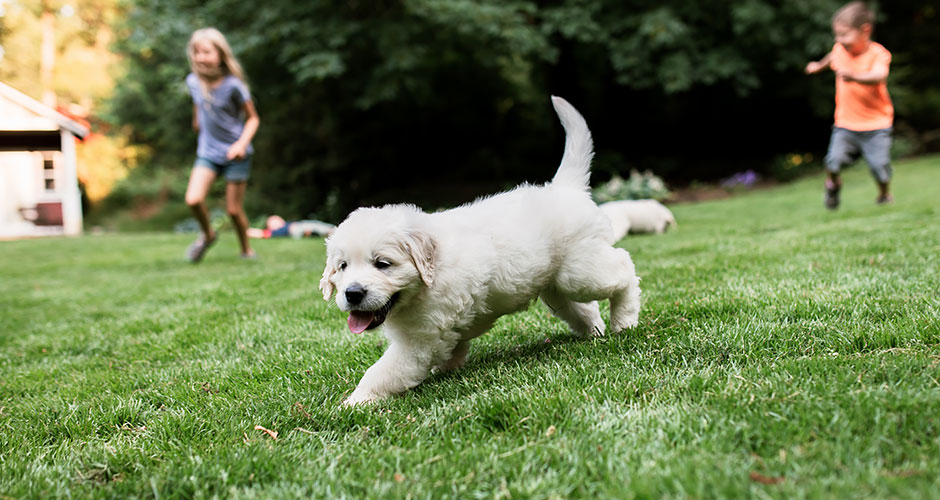
Want to raise a smart, well-mannered pup - and have tons of fun while doing it? These puppy games set the foundation for your puppy’s training while building a strong bond.
Our five favorite puppy games aren’t just for puppies. These training activities keep dogs of all ages active and engaged while helping to keep their skills sharp.
1. Hide and Seek
Hide and seek is a great puppy training game to teach recall, to come when called. This skill is incredibly useful if your puppy ever gets off-leash, escapes your home or yard, or even when your pup is in another room and you miss their cuddles. In Puppy Hide and Seek, you’ll always be the hider, as a dog’s highly sensitive senses of smell and hearing make them the best seekers.
To play, have your pup sit and stay out of sight while you hide. If your puppy doesn’t know how to recall yet, have a friend or family member help them wait in another room.
Then, call your puppy using your recall word of choice (like “here!” or “come!”). Give your pup lots of praise and a bite-sized treat when they find you.
2. Red Light, Green Light
“Red light, green light” is an excellent puppy training game to get your pup’s attention on walks, practice impulse control, and teach them to walk politely on the leash without pulling.
When you say, “green light,” run, jog, or skip with your puppy. Make it fun!
Then, say “red light,” and stop. Praise and, if you’d like, reward your puppy with a bite-sized treat when they stop. Pause for about three seconds, then say “green light” again, and off you go.
Remember, your puppy’s attention span is short and precious, and the outside is fun and distracting. Teach your puppy that it’s okay for them to sniff around and explore, but paying attention to you, when they’re asked, can be fun and exciting.
3. Monkey in the Middle
“Monkey in the middle,” played with two or more friends or family members, is a quick way to tire out your puppy. Just toss a soft dog toy back and forth, high in the air, and watch your pup race back and forth between you and the other player(s). Keep your pup from getting discouraged or disinterested by occasionally allowing them to catch the toy.
Your pup might decide to play keep-away, running off to play with their prize. Start tossing around a second toy to get your pup back in the game and to encourage them to share. This puppy training game can also be the start of building skills that lead to teaching your pup to fetch.
4. Teach Any Pup to Fetch
Some puppies, especially Retriever breeds, are more inclined to “fetch.” However, dogs of all sizes and breeds can learn to play fetch, and it just takes some more training to get the hang of it than others. “Fetch” can help mitigate tendencies to resource-guard, as your pup will learn to give you whatever is in their mouth when asked.
To teach “fetch,” start within very close range, tossing the toy no more than a foot or two away. When your pup picks up the toy, encourage them to bring it to you. At first, you can praise them and reward them with a treat when they happen to drop the toy anywhere near you.
In these early stages of fetch, you’ll be teaching your pup to trade. Give a toy, get a treat. As your pup starts to consistently bring you their toy, try tossing it a few feet away, then further as they get the hang of it.
As your pup learns to fetch, you can refine their skills by teaching them to place their toy in your hand. At first, hold your hand out and praise your pup every time their toy happens to land in your hand. Those incidental actions become intentional the more you praise and reward your puppy’s attempts.
Some pups pick up fetch within a few minutes. For others, these skills need to be built up over several training sessions. Mix it up with plenty of unstructured play. Keep it fun, short, and sweet.
5. Catch Me If You Can
“Catch Me If You Can” is a simple and easy, yet potentially life-saving puppy training game. Encourage your puppy to chase you by calling their name, then offering treats, toys, and praise when they catch up to you.
It’s always best to have your puppy chase you—not the other way around. Avoid chasing your puppy whenever possible. A puppy that learns to run away from you may be harder to catch if they escape your home or yard or if you ever need to remove something dangerous from their mouth.
If you ever need to catch a loose dog or puppy, try running away, rather than towards your pup. Running towards you should always be a good experience.








































 Live Chat