



SAVE AN EXTRA $5 - $20 OFFUse code PETS in cart (Exclusions apply)
Save 40% with first AutoShipUse code NEW40 (Up to $40 max. Exclusions apply)

While efforts are made to answer all questions as quickly as possible, if an immediate answer is required or if your pet is in need of urgent or emergency care, contact your pet's veterinarian immediately.
You will receive an answer from Dr. Lindsay and our vet/tech team as soon as possible, usually the same day.
All answers are provided for informational or educational purposes only, and are intended to be a supplement to, and not a substitute for, the expertise and professional judgment of your pet's veterinarian.
It may be necessary to consult your pet's veterinarian regarding the applicability of any opinions or recommendations with respect to your pet's symptoms or medical condition.
Close
An error has occurred, please reload the page and try again.
Close
While efforts are made to answer all questions as quickly as possible, if an immediate answer is required or if your pet is in need of urgent or emergency care, contact your pet's veterinarian immediately.
There is no answer related to your question
Both Omega 3 fatty acids and Omega 6 fatty acids are essential for pet health. Pets with allergic (flea allergy dermatitis), auto-immune (pemphigus, rheumatoid arthritis), or inflammatory (arthritis, glomerulonephritis) conditions need more Omega 3 fatty acids. Pets that have chronic illness (FIV, FIP, cancer) need more Omega 6 fatty acids.
Omega 3 fatty acids and Omega 6 fatty acids are both incorporated into cell membranes throughout the body. When the cell membranes are damaged, fatty acids are released. Released Omega 6 fatty acids are 10-100 times more likely to promote inflammation than are Omega 3 fatty acids. Inflammation is beneficial if there is an infection your pet needs to fight. Most pets, however, have health problems caused by too much inflammation (flea allergies, arthritis, auto-immune disease), so most pets benefit from supplements with higher concentrations of Omega 3 fatty acids.
How much omega 3 does my pet need?
Since Omega 6 fatty acids are so prevalent in pet food and treats, it's usually necessary to supplement with Omega 3 fatty acids to get a healthy 5:1 ratio. Without Omega 3 supplements, most pets eat a diet with a ratio of 20 Omega 6 fatty acid to 1 Omega 3 fatty acid. Omega 6 fatty acids from corn, safflower, sunflower, canola, and olive oil are usually cheaper, and more readily available than Omega 3 fatty acids from flax, fish, hemp, and walnuts.
How quickly will my pet benefit from omega 3 supplements?
While your pet begins benefiting quickly, you may not notice a difference from Omega 3 supplements for three to four months. Your pet's body will change from the inside out: first the individual cells, then the tissues, then the organs. Gradually you'll notice your pet's coat and skin become more radiant. When you see this, you'll know the internal organs, including the kidneys, liver, heart, and brain, are also experiencing more radiant health.
Key facts about Omega fatty acids
Are fish oil and cod liver oil the same?
No. Fish either store fats in their bodies (salmon, mackerel, menhaden, sardines, tuna) or in their livers (cod). Because fish also store Vitamins A & D in their livers, if a supplement contains fish liver oil, it will also contain high concentrations of Vitamins A & D. Avoid over-supplementing with fish liver oils because they may contain excessive levels of Vitamins A & D that can harm the liver. Supplementing with whole body fish oils prevents accidentally overdosing a pet with fat-soluble Vitamins A & D.
What does "essential fatty acid" mean?
An essential fatty acid is one that must be supplied in the diet because it cannot be manufactured by the body. The essential fatty acid for dogs is linoleic acid. Essential fatty acids for cats are linoleic acid and arachadonic acid. Some researchers believe alpha linolenic acid is also essential for dogs and cats.
Essential fatty acids aren't the only essential nutrient. There are about 50 nutrients or factors essential for good health: 20-21 minerals; 13 vitamins; 8-10 amino acids; two fatty acids. Pets also need fiber, friendly intestinal bacteria (probiotics), and digestive enzymes. We recommend supplements with fiber, such as Vetasyl. For enzymes, we recommend NaturVet Digestive Enzymes Plus Probiotic or Probiotic Chewys for Dogs.
What are the best sources of alpha-linolenic acid (an essential omega 3 fatty acid)?
Flax seed is 50% alpha-linolenic acid. Chia and Kukui (candlenut) oils are 30%. Hemp seed oil, 20%. Pumpkin seed oil, from 0-15%. Canola oil, 10%. Walnut oil, 3-11%. Soybean oil, 5-7%.
Ratio of omega 3 fatty acid to omega 6 fatty acids
Omega 3 fatty acid and Omega 6 fatty acid share a common enzyme. As the enzyme converts fatty acids from precursor molecules to active molecules, an overwhelming abundance of Omega 6 floods the enzyme. This flood causes the body to produce more of the Omega 6 metabolites and these metabolites promote inflammation. The places in the cell membrane that would ideally be filled with Omega 3 fatty acid get filled with Omega 6 fatty acid, and cells don't function optimally.
In the brain, which is 60% fat, learning and behavior is not optimum. In the skin, eyes and ears, reactions to allergens are exaggerated. Rather than a normal response to flea bites, yeast infection, or inhaled pollens, pets exhibits extreme itching, oozing and swelling. This extreme reaction can be lessened in many pets if they are supplemented with Omega 3 fatty acids.
Best fatty acids for shiny coats
Omega 6 fatty acids promote shiny coats. Saturated fats (bacon, beef tallow, lard) do not help the coat. To nourish the coat, keep the ratio of Omega 6 to Omega 3 at the optimum level, which many believe is 5:1. If your pet has a dandruff or seborrhea problem, in addition to fatty acids, supplement with zinc, folate, and retinoids.
Battery chickens, feedlot beef, and farmed fish
Battery chickens (raised in cages), feedlot beef, and farmed fish are all fed grains. Grains promote the production of Omega 6 fatty acids, and Omega 6 fatty acids promote inflammation. Fifty years ago the picture was different. It used to be that chicken and cattle were free range and ate plants. Fish were not farmed; they ate algae or smaller fish that ate algae. Fish, chicken, and cattle that eat plants make Omega 3 fatty acids; if they eat grains, they make Omega 6 fatty acids, which promote inflammation characteristic of allergies and heart disease. That's why it used to be healthy to eat eggs and beef, but now it's best to eat them in limited amounts. The same dietary advice holds for pets: supplement with Omega 3 fatty acids or feed kibble made from wild caught fish or free range chicken, chicken eggs, beef, or lamb.
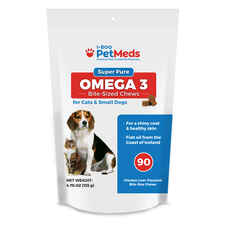
Many commercial foods do not contain high levels of Omega 3 fatty acids. We recommend supplementing your pet's diet with Super Pure Omega 3 or Brite Coat Chews
 Swipe
Swipe
 TOP
TOP


Mailing Address:
 Email Us
*If your pet is in need of urgent or emergency care, contact your pet's veterinarian immediately.









 Live Chat