



SAVE AN EXTRA $5 - $20 OFFUse code PETS in cart (Exclusions apply)
Save 40% with first AutoShipUse code NEW40 (Up to $40 max. Exclusions apply)

While efforts are made to answer all questions as quickly as possible, if an immediate answer is required or if your pet is in need of urgent or emergency care, contact your pet's veterinarian immediately.
You will receive an answer from Dr. Lindsay and our vet/tech team as soon as possible, usually the same day.
All answers are provided for informational or educational purposes only, and are intended to be a supplement to, and not a substitute for, the expertise and professional judgment of your pet's veterinarian.
It may be necessary to consult your pet's veterinarian regarding the applicability of any opinions or recommendations with respect to your pet's symptoms or medical condition.
Close
An error has occurred, please reload the page and try again.
Close
While efforts are made to answer all questions as quickly as possible, if an immediate answer is required or if your pet is in need of urgent or emergency care, contact your pet's veterinarian immediately.
There is no answer related to your question
What is diarrhea in dogs and cats?
Diarrhea in dogs and cats is loose stool caused by excess water in the feces. Loose stool may be accompanied by increased frequency or increased urgency.
Normally, adult pets defecate once a day if they are fed once a day, and twice a day if they are fed twice a day. Puppies and kittens defecate more often because they are fed more often. In dogs and cats, normal stool is large enough, and firm enough, to push against and empty the two glands situated in the rectum. These glands, also called anal sacs, discharge a malodorous material onto the stool that provides special signals for other pets.
Causes of diarrhea in dogs and cats
Diarrhea in pets can be caused by problems from within the digestive system itself, or by problems from outside the digestive system. Problems from within the digestive system include ulcers, food allergies, infections, poisons, worms, foreign bodies, and cancer. Problems originating outside the digestive system that cause diarrhea include anxiety, Addison's disease, liver disease, kidney disease, and a pancreatic disease called exocrine pancreatic insufficiency (EPI).
Acute or chronic diarrhea
Your pet's diarrhea can occur suddenly and resolve quickly (acute) or it can be chronic and last for months. Most cases of diarrhea are acute, isolated incidents that resolve easily.
Pets with acute diarrhea need medical attention if the diarrhea is bloody, or if it is accompanied by general signs of illness: fever, dehydration, abdominal pain, or weakness. All pets with chronic diarrhea need medical attention.
Pets most at risk for diarrhea
Diarrhea is one of the most common illnesses of dogs and cats, and is especially common in puppies and kittens. Diarrhea frequently occurs in pets kept in kennels and exposed to salmonella or parvovirus infections. Diarrhea is also common in pets eating garbage, poor quality food, or food that they are allergic to. Diarrhea occurs in pets drinking water contaminated with wild animal feces, which often contains giardia (parasites that infect the small intestine).
Puppies and kittens versus adult pets: Puppies and kittens have diarrhea much more often than adult dogs and cat do, and the causes of diarrhea in puppies and kittens are different than the causes of diarrhea in adult pets. Puppies and kittens have diarrhea from eating garbage, swallowing foreign bodies, infections, and from the bowel folding back on itself (intussusception). On the other hand, adult dogs and cats are more prone to diarrhea caused by disease: liver disease, kidney disease, Addison's Disease, and exocrine pancreatic insufficiency (EPI).
Types of diarrhea in dogs and cats
The intestines, which are also called bowels, have two distinct sections: small and large. It's useful to distinguish between large and small intestine diarrhea because different medical problems cause diarrhea in different sections of the intestines. For example, roundworms cause small intestine diarrhea and whipworms cause large intestine diarrhea.
With small intestine diarrhea, the stool is larger than normal and malodorous. Your pet defecates frequently and may lose weight. With large intestine diarrhea, your pet often strains to defecate, and produces a stool covered with mucus.
Small intestine diarrhea: The small intestine and large intestine have different functions. The stomach empties into the small intestine, delivering nutrients that are moved across the intestinal wall into the blood vessels lying just outside. The small intestine has three sections: the duodenum, jejunum, and ileum. The stomach and the first section of the small intestine, the duodenum, can develop bleeding ulcers. This blood is partially digested, causing the feces to be black and tarry. Black, tarry feces can also be caused by bleeding secondary to parvovirus infection.
Large intestine diarrhea: In the large intestine, water is removed from the feces. Some pets, especially Boxers, are prone to inflammation of the large intestine, which is called colitis. Pets with colitis pass diarrheic stools and large amounts of malodorous gas.
Bacteria within the intestines: Bacteria and microorganisms (also called flora) within the intestines can be friendly, good microorganisms or pathogenic, disease-causing organisms. Friendly bacteria help make vitamins and fatty acids, and they help produce mucus that lines the digestive system and protects it from infection and physical damage.
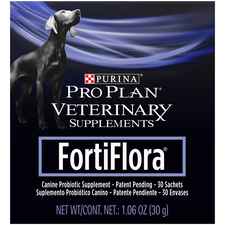
Supplements that supply good microorganisms to colonize the intestines are called probiotics. Probiotics protect your pet against inflammation, infection, diarrhea, and cancer. NaturVet Digestive Enzymes Plus Probiotic is an excellent source of gut-friendly probiotic microorganisms, such as Aspergillus Oryzae, Trichoderma Longibrachiatum, Aspergillus Niger, and Lactobacillus Acidophilus.
Not all bacteria and microorganisms in the digestive system are good. Pseudomonas, salmonella, and coccidia are disease-causing inhabitants of the intestines. In healthy pets, good microorganisms predominate and prevent pathogenic microorganisms from causing disease and diarrhea.
To maintain good gut bacteria, it's helpful to feed your pet prebiotics. Prebiotics, such as chicory and FOS (fermentable oligofructose fiber), are the nutrients that good microorganisms use to stay healthy. In pets fed FOS, intestinal cells are larger and healthier, have a thicker protective mucus layer, and are almost 100% more efficient at absorbing nutrients from food. Apple pomace and inulin, which are contained some dog food brands, are also excellent nutrient sources for good gut bacteria.
Constipation
Constipation is the opposite of diarrhea—it is a hard, firm, infrequent stool passed with straining. Constipation is common in dehydrated pets, dogs with enlarged prostates, and senior pets, especially senior cats. Providing extra fluids and providing fiber helps prevent constipation.
Among the best sources of fiber are Be Well for Dogs or Be Well for Cats, which can be fed at double the normal dose to help prevent constipation. For example, a senior 20 pound Poodle with constipation would benefit from two teaspoons of Be Well for Dogs sprinkled on his or her food daily. A senior cat would benefit from 1 ½ teaspoons of Be Well for Cats sprinkled on his or her food daily.
Diarrhea accompanied by blood and vomiting is a sign of serious illness—contact your veterinarian immediately to have the problem diagnosed and treated.
 Swipe
Swipe
 TOP
TOP


Mailing Address:
 Email Us
*If your pet is in need of urgent or emergency care, contact your pet's veterinarian immediately.









 Live Chat