



SAVE AN EXTRA $5 - $20 OFFUse code PETS in cart (Exclusions apply)
Save 40% with first AutoShipUse code NEW40 (Up to $40 max. Exclusions apply)

While efforts are made to answer all questions as quickly as possible, if an immediate answer is required or if your pet is in need of urgent or emergency care, contact your pet's veterinarian immediately.
You will receive an answer from Dr. Lindsay and our vet/tech team as soon as possible, usually the same day.
All answers are provided for informational or educational purposes only, and are intended to be a supplement to, and not a substitute for, the expertise and professional judgment of your pet's veterinarian.
It may be necessary to consult your pet's veterinarian regarding the applicability of any opinions or recommendations with respect to your pet's symptoms or medical condition.
Close
An error has occurred, please reload the page and try again.
Close
While efforts are made to answer all questions as quickly as possible, if an immediate answer is required or if your pet is in need of urgent or emergency care, contact your pet's veterinarian immediately.
There is no answer related to your question
There are 3 approaches to hyperthyroidism in cats: medication, surgery, and radiation.
Hyperthyroidism treatment: Pet medications
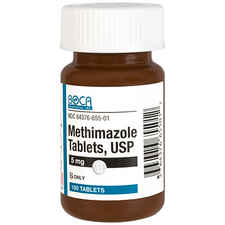
The prescription hyperthyroid medication Methimazole (brand name, Tapazole) is a tablet given daily. Methimazole can be specially formulated as liquid or as a transdermal gel that can be rubbed onto the ears. While it is generally easier to apply a medication to a cat's ears rather than to put the medication in the cat's mouth, not all cats receive a consistent, useful dose of medication with the transdermal approach. This inconsistency may be caused if the medication is applied without cleaning the ear first to remove old, dried medication that has formed a film on the skin.
Hyperthyroidism treatment: Surgery
Surgery to remove the thyroid is an effective cure; however, this surgery is very delicate. The parathyroid glands, which regulate calcium, are located on the thyroid gland. If the parathyroid glands are accidentally removed, your pet will develop a life-threatening drop in calcium. The remedy is to provide calcium supplements daily.
Hyperthyroidism treatment: Radiation
Radiation or radioiodine treatment targets the thyroid only, and spares the parathyroid glands. After treatment, your pet remains in the hospital for a week so that all the radioactive material is eliminated from your pet's body. No surgery is necessary, and it is relatively rare for the disease to reoccur.
As cats age, their kidneys often become less able to clear wastes from the body. When the hyperactive thyroid is pumping up the blood pressure, the amount of blood passing through the kidneys is higher than normal. With high blood pressure, even if the kidneys are not functioning well, wastes have ample opportunity to be cleared.
If a pet is treated for hyperthyroidism, his or her blood pressure returns to normal. Compared with the hyperthyroid state, the blood will no longer be moving through the kidneys as often, and gradually the amount of waste not cleared from the blood will increase. It is not that the kidney disease occurred after the thyroid problem was treated, but that the kidney disease was unmasked as the blood pressure returned to normal.
To predict whether your pet has the potential for kidney failure if his or her hyperthyroidism is treated, most veterinarians require that the pet receive oral Methimazole for several weeks before either surgery or radioiodine treatment. If your pet remains healthy and no kidney wastes collect in the blood as the thyroid levels normalize as the result of Methimazole, it is usually safe to consider permanent medication, surgery or radioiodine therapy. If your pet does show signs of kidney failure, many veterinarians recommend not treating the thyroid disease.
 TOP
TOP


Mailing Address:
 Email Us
*If your pet is in need of urgent or emergency care, contact your pet's veterinarian immediately.









 Live Chat